The Meeting Canvas defines meeting purpose, outcomes, decisions, participants, and inputs to ensure clear, effective meetings.
Core Question: What is this meeting for — and how do we make that explicit?
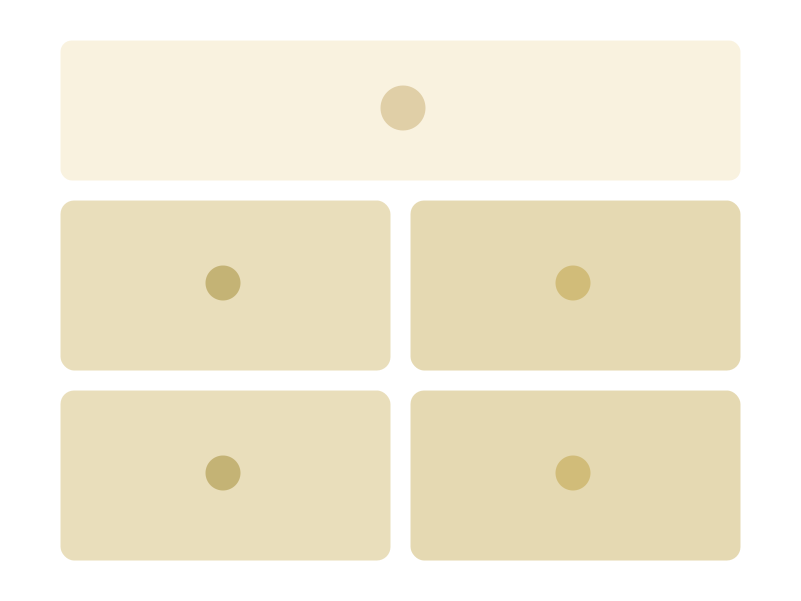
How often have you left a meeting thinking "What was that for?" The Meeting Canvas prevents exactly this. An agenda lists topics; a canvas defines why those topics matter, what decisions they serve, and who needs to be there to make those decisions. A template prescribes format; a canvas is a thinking tool that helps you design the right format for your specific context.
The power of the canvas lies in its chain of logic: Purpose drives Outcome, Outcome drives Decisions, Decisions drive Participants, Participants drive Inputs. If you can't answer the first question — "Why does this meeting exist?" — the meeting probably shouldn't exist. If you can't define the outcome, people will leave feeling the meeting was pointless.
Details
The Core Questions
Every Meeting Canvas is built around questions forming a logical chain:
- Why are we doing this meeting? (Purpose) — The real, current reason this meeting exists. Not "because we always have it."
- What is the outcome? (Result) — What is tangibly different after this meeting? Decisions made, blockers resolved, plans adjusted.
- What decisions are we making? (Decisions) — The specific decisions this meeting must produce. If there are none, reconsider whether you need a meeting.
- Who do we need to make the decisions? (Participants) — Only the people needed for those decisions. Not "the whole team" by default.
- What information do we need? (Inputs) — The data, reports, or preparation required before the meeting so time isn't wasted gathering information during it.
Practical Examples
FL2 Weekly Sync Canvas:
- Purpose: Ensure cross-team alignment on delivery progress
- Outcome: Updated delivery status, resolved cross-team blockers
- Decisions: Priority adjustments, blocker escalations
- Participants: Team leads, product owner, scrum masters
- Inputs: Updated boards from each team, blocker list
FL1 Retrospective Canvas:
- Purpose: Learn from the last iteration and improve
- Outcome: 1–3 concrete improvement actions
- Decisions: Which improvements to implement next iteration
- Participants: The team (those who did the work)
- Inputs: Metrics from the iteration, feedback collected during the sprint
Smells — When to Look Closer
- Treating the canvas as a bureaucratic duty — filling it out without actually thinking about the answers defeats the purpose
- Vague purpose: "alignment" or "sync" without specifying what needs aligning — if you can't be specific, the meeting lacks focus
- Inviting everyone "just in case" instead of deriving participants from decisions — this inflates meetings and dilutes accountability
- No defined outcome — people leave the meeting unsure what was accomplished
Related Patterns
- Meeting Container is what the canvas describes and designs
- Interactions are the building blocks that the canvas structures into a coherent meeting
- Categories can be used to verify whether the canvas covers all relevant dimensions
Your play!
If you want to use this in your worksystems-design sessions, here is all the material you need.
More about this
These patterns are part of the Flight Levels thinking and design model. If you want to learn more, take the Kick start path to Flight Levels Now!