Identify needed interactions at board coordination points and bundle them into meeting containers.
Core Question: Which interactions do we need where?
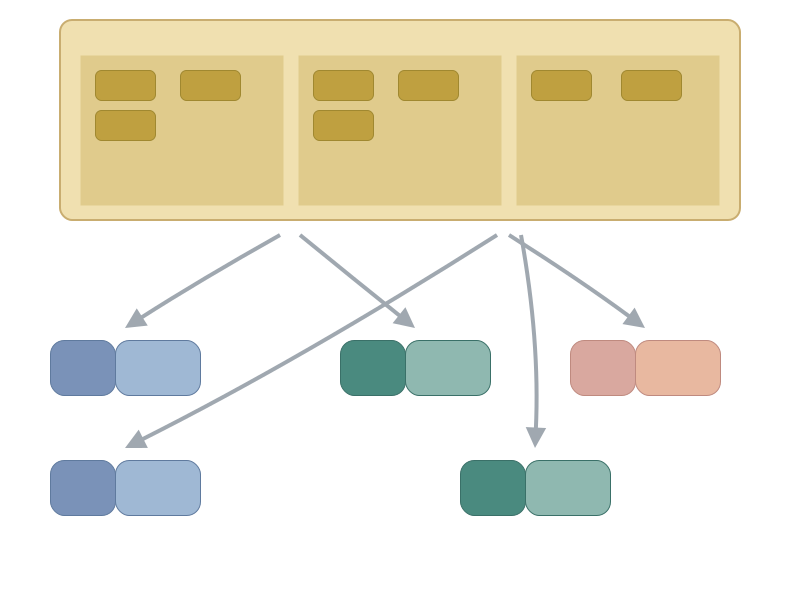
The process follows a clear logic: First, read the board for coordination points — where work enters, changes hands, piles up, needs decisions, or leaves the system. Then, for each coordination point, define the Interactions needed using the verb-noun approach. Finally, bundle those Interactions into Meeting Containers and arrange them in a Meeting Cadence.
This ensures every interaction has a reason rooted in the actual workflow — not in convention, habit, or imitation. If an interaction can't be traced back to a coordination point on the board, question whether it needs to exist.
Details
Reading the Board for Coordination Points
Possible coordination points to look for:
Point Type | What to look for | Typical Interactions needed |
Entry Points | Where work enters the system | Clarify requirements, Estimate effort |
Handoff Points | Where work changes hands between roles/teams | Confirm readiness, Answer questions |
Waiting Areas | Where work piles up or gets stuck | Identify blockers, Resolve dependencies |
Decision Points | Where choices must be made | Make priority decisions, Select work |
Exit Points | Where work leaves the system | Verify completion, Demonstrate value |
Dependency Points | Where systems connect to other systems | Coordinate with other system, Synchronize timing |
Practical Examples
Board reading reveals a bottleneck: The Testing column has 10 items while all other columns have 2–3. This waiting area needs a Blocker Management Interaction — "Identify and resolve testing blockers." This Interaction gets bundled into the Daily Standup Container.
Board reading reveals a handoff gap: Items sit in "Ready" for days before moving to "In Progress." The handoff between Product and Development has no interaction. An Interaction "Confirm handoff readiness" is needed — either as part of the Daily Standup or as a dedicated bilateral sync.
FL2 board reading: Three team boards feed into an FL2 delivery board. The entry point where team outputs become delivery items needs coordination Interactions: "Review team outputs," "Identify cross-team dependencies," "Update delivery status." These bundle into an FL2 Weekly Sync Container.
Smells — When to Look Closer
- Starting with meeting formats ("we need a standup") instead of reading the board — format-first design serves convention, not the workflow
- Designing interactions without a board — no visualization means guessing at coordination needs
- Skipping the Interactions step — identifying coordination points but jumping straight to "let's have a meeting" without defining what happens inside
- Reading the board once and never revisiting — coordination needs change as the system evolves
Related Patterns
- Interactions provides the verb-noun naming approach for what you discover on the board
- Interactions → Board closes the loop — interaction outcomes flow back onto the board
- Board ↔ Meeting Alignment takes this idea to the system level
Your play!
If you want to use this in your worksystems-design sessions, here is all the material you need.
More about this
These patterns are part of the Flight Levels thinking and design model. If you want to learn more, take the Kick start path to Flight Levels Now!