
Ineffective Iterations occur when ambiguous work is organized serially through email, leading to slow feedback loops, and can be improved by shifting to direct collaboration in Studio Mode.
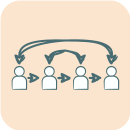
Key Points
Ambiguous work organized serially through email. Leads to slow, expensive feedback loops and constant back-and-forth.
The Problem: No direct collaboration, feedback loops run asynchronously (mostly email).
The Solution: Recognize ambiguous work → shift it to Studio Mode.
Details
Ineffective Iterations is an anti-pattern that occurs when ambiguous, uncertain work is organized like Factory Mode – serially, without direct collaboration. This leads to slow, expensive feedback loops.
How Does Ineffective Iteration Emerge?
Typical Scenario:
- Complex request comes in (e.g., new product request, design problem)
- Person A processes their part
- Hands off to Person B
- Person B sees problem → writes email to Person A
- Person A responds after delay
- Person B has new questions → email again
- Loops go back and forth multiple times
- At the end: Weeks for something that could have been clarified in 1-2 hours
Symptoms of Ineffective Iteration
- Endless email chains without resolution
- Multiple feedback loops of the same task
- High wait times between steps
- Quality suffers, still "not right"
- Participants feel frustrated and misunderstood
- Work takes much longer than expected
Why Does This Happen?
For ambiguous work, asynchronous communication is ineffective:
- Email/text are less precise than face-to-face
- Misunderstandings multiply over several rounds
- Context switching costs time (who still cares about this?)
- Feedback takes long, momentum is lost
The Paradox: You want to be "efficient" through serial work, but make it much less efficient.
Practical Examples
Mistake: Design Request Runs Through Ticketing System
- Problem: Designer and requester don't speak directly
- Multiple rounds: "What do you mean by...?" → email ping-pong
- Solution: Studio Mode: Direct meeting designer+requester, clarify in 30 min
Mistake: Procurement with Ambiguous Orders via Email Exchange
- Problem: New, complex requests handled serially
- Feedback loops: "Can you give more details?" x5
- Solution: Studio Mode: Daily team meeting for complex cases
Mistake: Software Development with Waterfall for Uncertain Requirements
- Problem: Requirements phase takes months, still unclear
- Feedback loops: After development, requirement was wrong
- Solution: Studio Mode: Agile with frequent customer checks
The Solution: Quickly Switch to Collaboration
Recognition Signs for Ambiguous Work:
- Does the task keep coming back?
- Many "one more question..."-messages?
- People saying "I didn't understand it that way"?
- Are there multiple possible interpretations?
- Impossible beforehand to know exactly what needs to be done?
If yes → Studio Mode!
Practical Measures:
- Recognize ambiguous requests early
- Put involved people directly together (synchronous, face-to-face if possible)
- Clarify in one meeting what would otherwise take 5 email rounds
- Document the result
- Back to Factory Mode for implementation
Ineffective Iterations in Dynamic Work Design
Ineffective Iterations is the opposite of good Dynamic Work Design. It occurs when you don't properly distinguish between well-defined and ambiguous tasks.
Better: Shift ambiguous work immediately to Studio Mode, not sequentially plan it.
This pattern is one of the two "poles" of the Axis of Frustration (the other pole being Wasted Attention).
Common Mistakes
- Using waterfall for uncertain projects
- Processing complex requests without direct exchange
- "We'll clarify that later" → leads to rework
- Asynchronous communication for ambiguous problems
Better: Quickly switch to synchronous collaboration
More about this
Dynamic Work Design was developed by Nelson P. Repenning and Donald C. Kieffer at MIT Sloan. Start with the foundational article "A New Approach to Designing Work" (2018) and watch "Unlock Your Organization's Full Potential with Dynamic Work Design" by Don Kieffer to see practical applications.